WIPI
News - Archive #1 PREMIERE
ISSUEView
Current list of nominees.
|
Industry
News #1 - Archive #1 We
are happy to report that there is a new 'European Photography Prize'. The prize
money amounts to 25,000 EURO. The
REIND M. DE VRIES FOUNDATION awards a prize entitled 'the Reind M. De Vries Foundation
European Photography Prize', which is intended to support photography in the broadest
sense of the word. Everyone
living in the geographic area of Europe is eligible to compete for the prize.
Participants may submit a personal application dossier,
or they may point out possible candidates. Aim
The foundation was created with the aim of setting
up and awarding an international prize, to be called the 'Reind M. de Vries Foundation
European Photography Prize'. The
prize of 25,000 EURO is to be awarded in appreciation of an artistic, theoretical,
scientific, technological or agogical achievement or contribution that has proved
to be essential or substantially significant to the progress and promotion of
photography in the real sense of the word. Description
This means: the invention, discovery or elaboration
of techniques, methods, materials and instruments that can be used for realising,
recording, transmitting or registering photographic images in a tangible form.
These recorded images may be the result of one or more photochemical,
analogue photographic processes.
This also
includes: scientific research and the historical and theoretical study of a specific
field of photography or an important contribution or achievement stimulating the
progress of photography or extending its scope, social influence and effect. Setting
up an exhibition or writing a book are also eligible categories for the prize.
The candidate is free to choose how he presents his application file. The
prize can be awarded to one private individual, to a co-operative partnership
or to the leader of a team. The
REIND M. DE VRIES FOUNDATION accepts nominations and awards the prize on the basis
of the proposals of an international jury, consisting of: President
(who has no vote); Eugene Van Hoye, Director
'Museum
voor Fotografie', Antwerp, Belgium
Secretary
(who has a vote): dr. Johan Swinnen, professor
'Higher
Institute for Fine Arts', Antwerp, Belgium
Voting
Members:
Pool Andries, curator 'Museum voor
Fotografie', Antwerp, Belgium
Jean Back, director
of the 'Family of Man' Museum, Clervaux, Luxembourg
Jan
Coppens, photography historian, Eindhoven, the Netherlands
David
Elliott, Director 'Moderna Museet', Stockholm, Sweden
Roger
Erlandsen, Director 'Cultural Hermitage', Oslo, Norway
Joan
Fontcuberta, visual artist and publicist, Barcelona, Spain
Jean-Luc
Monterosso, Director 'Maison Europeenne de la Photographie', Paris, France
Andreas Muller-Pohle, visual artist and publisher 'European
Photography', Gottingen, Germany
Dr. Laurent
Roossens, Agfa-Gevaert, Mortsel, Belgium
Val
Williams, London, England, Curator 'Hasselblad Foundation', Goteborg, Sweden
Correspondence:
dr. Johan Swinnen:
e-mail:
info@devriesfoundation.org
Website: http://www.devriesfoundation.org
back
2 the top
|
Industry
News #2 - Archive #1
U.S. News & World Report has come out with a list of the top academic MFA photography
programs - Fine Arts Specialities - for the year 2000. They are: Rochester Institute
of Technology (NY) - The
Art Institute of Chicago(IL)
- University
of New Mexico(NM)
- Rhode
Island School of Design (RI)
- California
Institute of the Arts (CA)
- San
Francisco Art Institute CA)
- Yale
University (CT)
- School
of Visual Arts (NY)
- Art
Center College of Design (CA)
- University
of California-Los Angeles (CA)
- Cranbrook
Academy of Art (MI)
- Syracuse
University (NY)
- Temple
University (PA)
- Pratt
Institute (NY)
- Ohio
University(OH)
- University
of Arizona(AZ)
- University
of California-Irvine(CA)
|
Gallery
News - Archive #1 "Behind
the Redwood Curtain:
Women Photographers of Humboldt County, California 1850-2000"
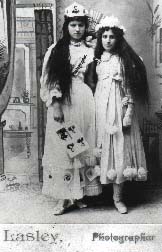
Rosie
Lasley with Bertha Perigot, photographers 1896
Using
Humboldt County as a focus region, the Women in Photography International Archive
has undertaken a comprehensive study of all women who have ever worked in the
field of photography in Humboldt County, from 1850 (the date of the first settlement)
through the year 2000. Why limit this study to women photographers? Women have
been almost universally ignored in the existing literature of the history of photography.
While the aims of this three-fold project (exhibition, book & community outreach)
will do little to rectify the glaring oversight in our photographic heritage,
it does provide a unique opportunity to highlight the contributions of one group
of female photographers in a notably male-dominated portion of the world. Another
important goal is to champion the creative productions of women in general. At
the same time, by studying the photographic history of both men and women over
the past 150 years, we can demonstrate that this male-to-female imbalance is itself
now in the process of mirroring national trends. Local university photography
programs, long the province of men, have shifted so rapidly in recent years that
the majority of new students today are female. Finally, "Behind the Redwood Curtain"
provides a unique opportunity for comparing this region's women photographers
with other geographic areas. While a comparison may be drawn between Humboldt
County and any rural county in America, it might just as easily be applied to
a densely populated urban center such as New York City. Long
regarded as a wilderness until white settlement began in 1850, the Humboldt region
lies some 275 miles north of San Francisco and contains a land mass of 3,573 square
miles. Reputed to be the home of the elusive "Big Foot", Humboldt County is mountainous,
laced with numerous rivers, and bounded by vast forestlands. In modern times,
the population has hovered around 100,000, with the majority of the county's citizens
clustered around Humboldt Bay which incorporates the principle cities of Eureka
(Humboldt County's largest urban center) and Arcata (Home of Humboldt State University).
Logging, ranching and maritime industries have constituted the principle economic
base, while rains and dense fogs shroud the land. Groves of giant redwood trees
dominate the landscape; often so thick and forbidding that even the local Native
American inhabitants avoided their dark domain. Not
surprisingly, Humboldt County has frequently been stereotyped as a "man's domain",
where women are considered scarce. Pejorative slogans like: "Humboldt Honey" and
"Where Men are Men, and so are the women" imply that only an independent-minded,
burly woman with unshaven legs and armpits, ever found her way to this remote
and inhospitable land. While much has changed over the past 150 years, both geographically
and regarding the female population of Humboldt County, many of these negative
attitudes linger still. The
makers of the 100 photographs selected for the exhibition "Behind the Redwood
Curtain" represents roughly 10% of the 700 plus women who have been linked to
photography in Humboldt County over the past 150 yrs. Although there are a number
of motion picture and videographers in the area, we have elected to limit the
exhibition to still photographers only. The image selection represents a wide
spectrum of interests and backgrounds. Some have used a camera for a lifetime,
while others still count themselves as beginners, including several young women
who are still in high school. You
are invited to celebrate the photographs in this exhibition as it travels and,
where possible, to congratulate the women who made them. We also trust that, at
least for the women photographers of Humboldt County, California, the "redwood
curtain" has been lifted, letting the sunshine of diversity and creativity shine
through brightly. Exhibition
Dates and Sites: - Reese-Bullen
Gallery, Humboldt State University
4 November - 18 December 1999
- International
Photography Hall of Fame, Oklahoma City, Oklahoma
15 February - 31 March 2000
Other
venues are pending. Curators
for "Behind the Redwood Curtain" are: - Peter
E. Palmquist, an independent historian of photography, specializing in pioneer
photography, the American West, California photography to 1950, and women in photography
globally. He is founding curator of the Women in Photography International Archive
and author of more than forty books in the field.
- Gia
Musso, an historian of California and the West, and Associate Curator of the Women
in Photography International Archive. She has most recently co-authored the book:
Women Photographers - a Selection of Images from the Women in Photography International
Archive, 1852 - 1997. Gia is the project manager for this exhibition.
Peter
Palmquist
Women In Photography International
Archive:
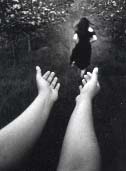
I Hold You
Close 1999 by Jorden Nigro back
2 the top
|
Marketing
News - Archive #1 Get
Going with Greeting Cardsby
Maria Piscopo Electronic
Rights and Promotion Rights Only in Exchange for Piscopo Web site link http://www.mpiscopo.com
As
we enter the end of a very turbulent decade for the photography business, new
clients and markets for your images are topics close to the heart of every photographer.
You have experienced upheavals in new technology, in the clients and in the budgets
for your photo services. In addition, you are probably looking for a market for
many “personal” images not marketable to traditional commercial clients.
How
about greeting cards? Whatever happens with the technology or commercial clients,
the consumer greeting card market is growing and here to stay. The end of this
century has seen tremendous growth of photo image use by the alternative greeting
card publishers. With gross sales projections in the six and one half billion-dollar
range the major publishers buy shelf space in major consumer outlets for their
cards to dominate this market. You’ll find competition to get into their talent
pool is quite fierce. Since nearly fifteen percent of the above sales are generated
from alternative greeting card publishers, they may be your best bet for entry
into this market. This figure is expected to increase to eighteen percent by the
end of this year, an almost two billion dollar slice of the “pie”. Retail distribution
is the key to greeting card sales success. Your first decision is whether to find
a publisher to print and distribute your cards and reach the end consumer or to
self-publish. How
To Submit To Publishers
The submission process begins with researching The
Photographer’s Market Book 2000; (Writer’s Digest Books in Cincinnati, OH). Though
not a “phonebook” of all greeting card publishers, it lists extensive information
provided by those publishers looking for photo images. So if a publisher is not
listed for any given year, that’s their way of saying “We’re full up!” The bonus
is you get to talk to publishers that want your submissions. Follow the submission
guidelines! Though it is always good procedure to call if you have any questions
about submission directions, it is always better to send ten great shots than
100 mediocre images. Edit your work ruthlessly and follow the recommendations
for submission formats very carefully. Always send a self-addressed stamped envelope
for the return of your work. You should also design produce and print a promo
piece for the publisher to keep on file. Since the shelf life of a photo greeting
card is only thirty to forty five days, greeting card publishers are constantly
in need of new, strong selling images! Payment
Terms
Many publishers choose to pay a royalty of 2% to 10% on the wholesale
price based on sales of your cards and have set payment schedules (quarterly or
annually). Be sure to determine whether royalty is based on cards printed or cards
sold. Whenever possible, ask for a guaranteed advance. As with any photography
pricing, everything is negotiable! Some pay a flat fee royalty based on each printing
of your images. For example, the first printing of 5,000 of each card design pays
the photographer from $75.00 to $100.00 for a postcard use and $150.00 to $175.00
for greeting card. In addition, each photographer gets one hundred cards free,
making great promo pieces for other clients and markets. Contracts must be discussed
and the issue of exclusivity and photo credits negotiated. For example, some publishers
get five-year exclusive use of your image for greeting card market but always
give photographer’s credits. Always record the usage you are selling. Though your
image can then be sold in other markets, any original or subsequent clients should
know it is on the greeting card market. How
To Self-Publish Your Own Cards
Since the greeting card industry has about
a 30% turnover in new start-up publishers each year self-publishing is a good
option to consider. The key to self-publishing your own line of cards is to find
a theme. With a “theme” that is well defined, the retail distribution outlets
can be easily identified. To define your theme and market, start your research
with a focus group. For example, for every group of images you want to produce,
prepare a presentation binder of prints. Select the prime target audience, a group
of women, age’s twenty-five years to fifty-five years, to review the presentation.
As questions like, “What cards would you buy?” instead of the less useful question,
“What cards do you like?” This information will help you distinguish your favorite
images from a best-selling greeting card! Knowing that women purchase 90% of greeting
cards will have an influence on your theme and image selection. Since the major
publishers have the grocery chains and department stores “locked up”; self-published
and alternative greeting card published cards are more successful in their own
unique outlets. These include stationary stores, retail gift shops, craft shops,
bookstores, airport and hotel gift shops, car washes, even hardware stores. The
key is to concentrate on a theme and find the best retail outlet for it. Also,
when you self publish, remember that retailers need to charge twice the wholesale
price when you calculate your design and production costs. Marketing
Tips for Self-Published Greeting Cards
Start with a line of cards, six to
twelve designs would be a minimum. Look at what’s currently selling and then figure
out your own designs. Put your sample book together then find the retail locations
that best fit the cards. Plan your card production steps carefully. First, cut
card stock to size. Second, score and fold card stock. Third, stamp my logo on
back of card. Fourth, Paste color photographic print on front of card, add title
and signature. Fifth, Package card using plastic sleeve with envelope and promotional
copy. Plan for start-up time and production costs. These include research, card
stock, envelopes, and packaging, creating the images, photo costs, lots of phone
calls and your business cards and letters. Producing a catalog of your card designs
is extra work but today’s desktop publishing software should make this easier.
Look at other markets for your images after they have been greeting cards. Check
on stock houses, poster and calendar publishers, and art fairs and fine art prints.
back
2 the top
|
Book
Review - Archive #1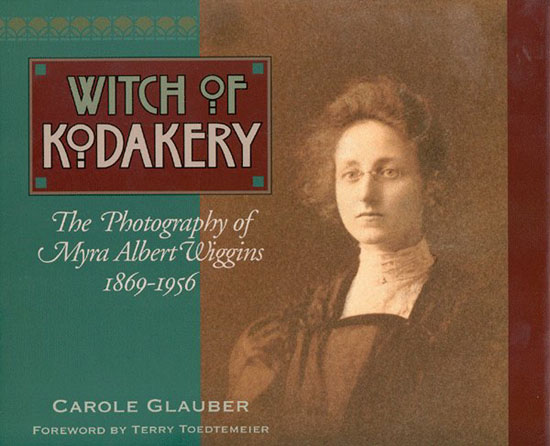
Witch of Kodakery |
The
Photography of Myra Albert Wiggins, 1869-1956,
by Carole Glauber, with a
forward by Terry Toedtemeier.
Washington
State University Press, Pullman (1-800-354-7360)
Myra
Albert Wiggins, photographer, painter, writer, and musician, lived and worked
in the Pacific Northwest. Witch of Kodakery: The Photography of Myra Albert Wiggins,1869-1956
is the first comprehensive look at Wiggins' life and work. Her powerful and enduring
photographs encompass Dutch genre, landscapes, portraits, family life, and scenes
from her travels in the Northwest and abroad. Despite living in faraway Salem,
Oregon, Wiggins' pictorial photographs appeared in national and international
journals and hung in salons in the United States and Europe. Wiggins' artistic
success led to her admittance into the Photo-Secession in 1903. The
implications of Wiggins' work within the context of social, cultural and technological
changes are considerable. Her life intersected the Arts and Crafts movement, the
invention of half-tone printing, and the development of the dry plate and roll
film - all highly influential to her style of photography. Few women in the 1890's
struggled to balance the demands of marriage and motherhood with a career as Wiggins
did. While
Wiggins' story weaves a description of turn-of-the-century amateur photography,
it also portrays the intertwining of personal ambition with collegial friendships,
the filtering of national photographic politics westward to Salem, and how Photo-Secession
membership both helped and hindered Wiggins' photographic pursuits. Her astuteness
for self-promotion dovetailed with the same media and corporate hierarchy that
happily endorsed her work. The title of the book derives from an Eastman Kodak
promotional campaign employing witch and witchery imagery as a metaphor for the
magic, charm, and fascination of photography. Later
in life, while a grandmother, Wiggins built a second career as a painter and mentor
to artists. Although her paintings did not explore new ideology and technique
as did her photographs, she continued to garner awards and recognition for her
work. Culminating her career, the Seattle Art Museum in 1953 and the DeYoung Museum
in San Francisco in 1954, honored her with retrospective exhibitions of her photographs
and paintings. Her vivacity and devotion to her work remained intact until her
death at age 86. Extensive research using diaries, letters, newspapers, photographic
journals, Wiggins' photographs, exhibition catalogs, and interviews with family
members and friends create a revealing and thought provoking narrative about an
artist and her times. |